
Glossary term
Web-Safe Colors
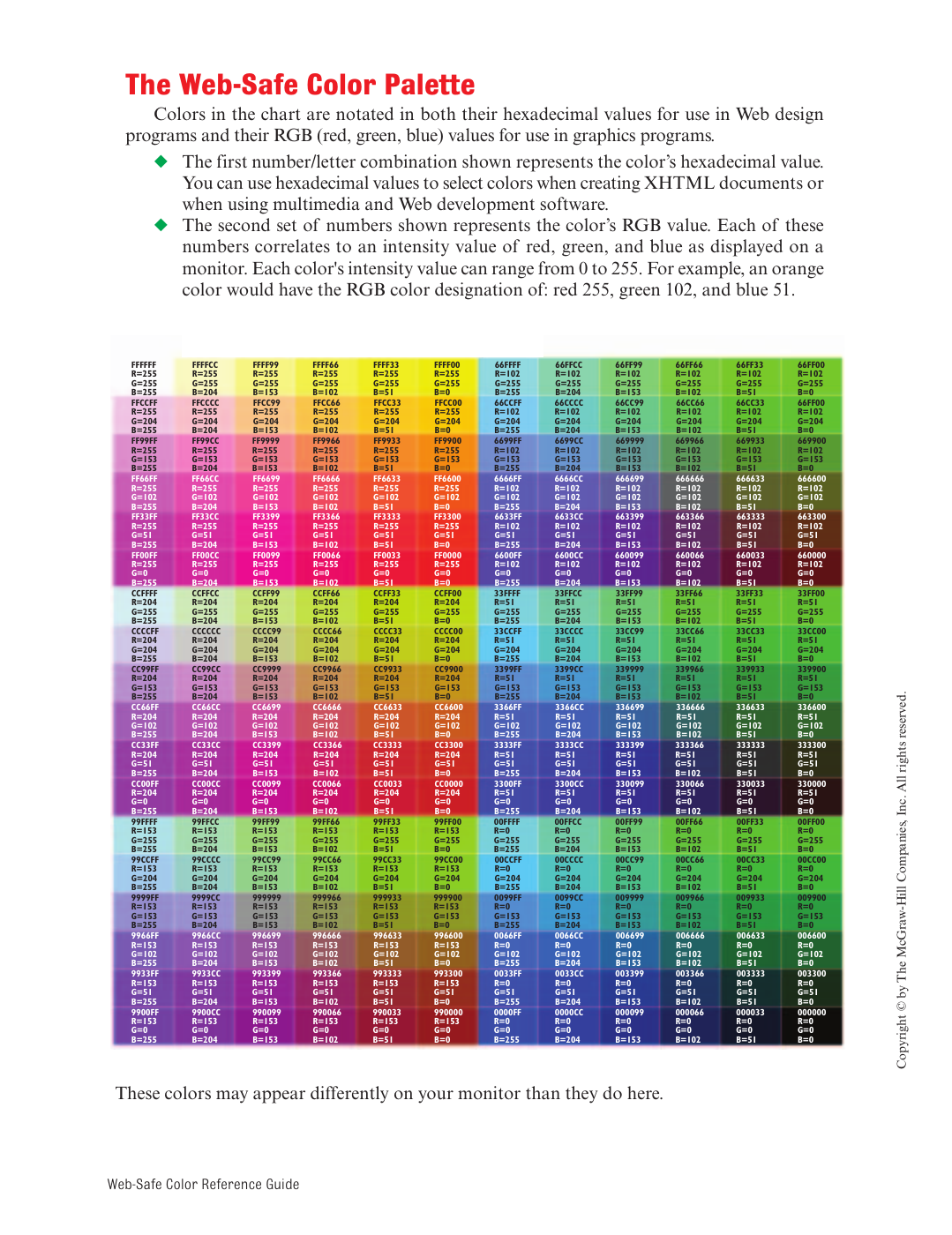
Web-safe colors are a historical palette of 216 RGB colors selected to reduce palette-related color changes on common 256-color computer displays.
Choose from the approved squares
The old palette restricted each RGB channel to six values: 00, 33, 66, 99, CC, and FF. Six choices for red, six for green and six for blue produce 216 combinations.
An HTML color such as #336699 fits that pattern. A carefully chosen in-between shade might have to be remapped or approximated on a limited-palette system. The constraint was practical enough to end up in teaching charts and design workflows.
When the missing color became a pattern
Dithering approximates a color using a pattern of available colors. From a distance the eye blends them; up close the pattern is visible. A flat area that looked smooth in one environment could acquire a texture in another.
The surviving University of Delaware tutorial explains the cross-platform palette problem in the language of its time. It also warns that the common palette was not necessarily the best choice for every reduced-color image. A photograph has different needs from a flat button or page background.
“Safe” was about the palette
The name did not guarantee that a color would look identical on every monitor. It did not guarantee readable text, accessible contrast, or suitability for a brand either. Those are different decisions.
Modern CSS and displays support far more than those 216 colors. The old palette is a record of a production constraint designers had to plan around. Today, choosing a color is more likely to raise questions about contrast, color spaces, and display consistency than whether it falls on one of those approved squares.
Ephemera
An original reference chart, followed by a new Moonvine demonstration. The demonstration is labeled separately so a reconstruction cannot be mistaken for a period artifact.
MOONVINE DEMONSTRATION
All 216. Choose your compromise.
Six values per channel. Select a swatch to inspect its hexadecimal value.
A new Moonvine rendering of the historical palette. Your modern display is not being restricted to 256 colors.
Frequently asked questions
Why are there 216 web-safe colors instead of 256?
The common palette uses six values for each of three RGB channels: 6 × 6 × 6 = 216. It was a cross-platform subset, rather than all the colors a particular 8-bit system could display.
Do I still need to use web-safe colors?
Usually no. Modern web design can use the much broader color capabilities of CSS and contemporary displays. Use the historical palette when it serves the design or a specific compatibility requirement.
Are web-safe colors accessible?
Not automatically. Readability depends on how foreground and background colors work together, along with text size and other factors. Belonging to the 216-color palette does not establish adequate contrast.
Related reading
 Still or moving
GIF
GIF, short for Graphics Interchange Format, is a raster image format that supports indexed color, simple transparency, and frame-based animation.
 RELATED TERM
Image Optimization
Image optimization means delivering an image with appropriate dimensions, format and compression for where it appears. It reduces unnecessary download weight while preserving the detail people need to see.
 RELATED TERM
Color Contrast
Color contrast describes the difference in relative luminance between colors, commonly expressed as a ratio for accessibility evaluation.