
Glossary term
Bulletin Board Systems (BBS)
A bulletin board system, or BBS, is a computer service where users can read and post messages and, depending on the system, exchange files, chat, or play games. Early hobbyist BBSes were commonly reached by dialing the host computer over a telephone line with a modem.
The address was a phone number. If someone else was already on the line, you might have to try again later.
Calling a computer over the phone
A host computer answered a modem call and presented a text interface. The caller used a terminal or terminal program to read the prompts and send commands. A system with one incoming line could serve one caller on that line at a time.
A 1978 CBBS manual describes entering messages, reading earlier ones, and reviewing message summaries over an ordinary telephone connection. You did not need a web browser.
Chicago’s CBBS and the hobbyist beginning
Ward Christensen and Randy Suess created Chicago’s CBBS in 1978, the canonical starting point for the hobbyist dial-up BBS. Christensen worked on the software and Suess on the hardware.
Earlier systems such as PLATO and Community Memory had already brought people together through computers. The hobbyist BBS gave someone with a computer and a phone line a way to run a meeting place of their own.
Messages, files, and door games
Features varied. Messages and files were central to many boards; later systems could offer live chat, polls, and external programs known as door games. The system operator—usually called the sysop—chose what to make available.
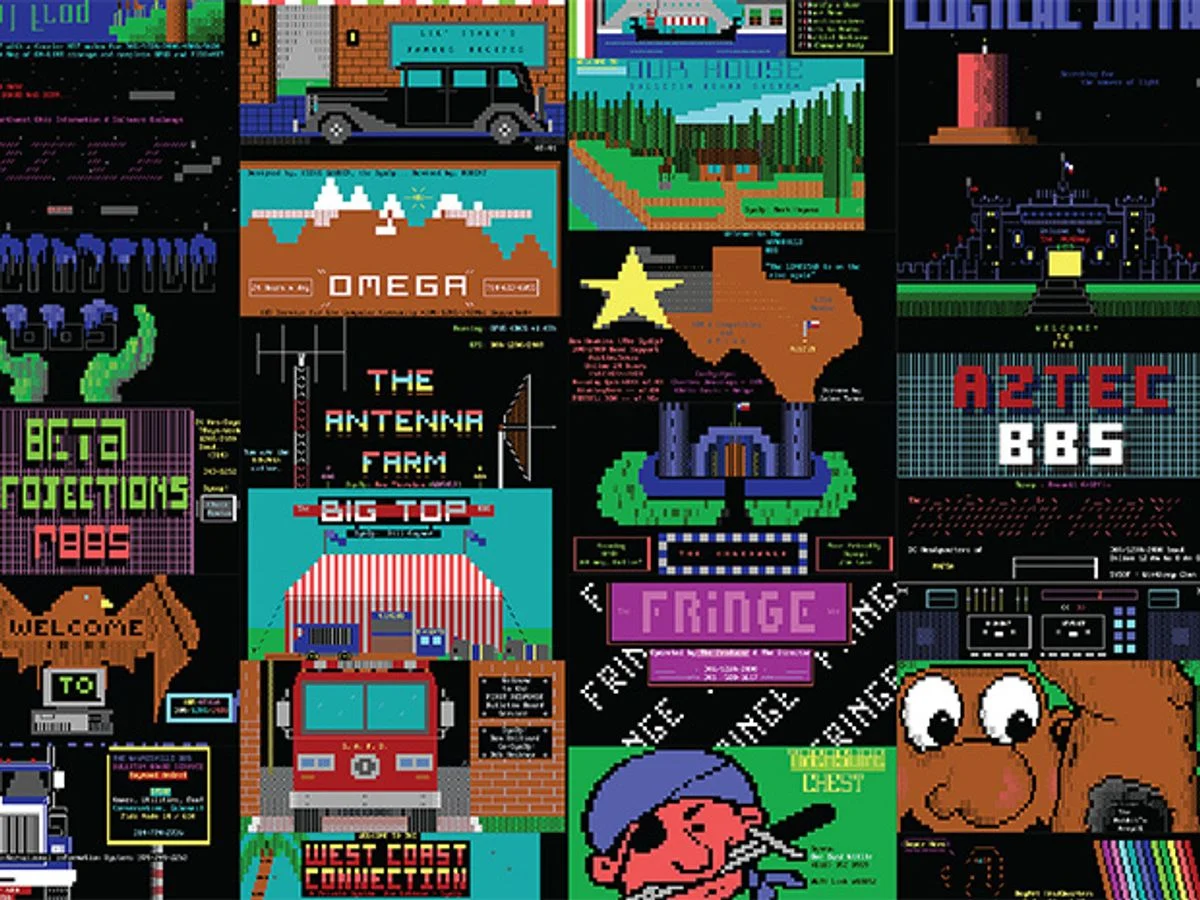
A board could develop its own subjects, regulars, and visual personality. The preserved welcome screens below show how much identity could fit into a terminal window.
Were BBSes part of the internet?
A standalone dial-up BBS did not require an internet connection. You could call its computer directly. Some boards later exchanged messages through networks or became accessible over internet protocols.
FidoNet connected BBSes, while modern software such as Synchronet supports internet connections including Telnet and SSH. “BBS” names the service, not one mandatory way to reach it.
How is a BBS different from Usenet or IRC?
A BBS is an individual hosted service. Usenet distributes discussion articles among news servers. IRC organizes live conversation in channels.
They could overlap in practice: a board might connect to other networks or offer chat. The useful difference is how the service organizes participation and exchanges messages.
Making an interface out of text
A welcome screen could establish the board’s character before the caller read a single discussion. Letters, symbols, and terminal color controls could make a logo, illustration, or elaborate menu.
ASCII and ANSI art are related but not identical terms. ASCII art uses characters to make pictures; ANSI terminal controls can add color and positioning beyond the characters themselves.
Do bulletin board systems still exist?
Yes. Maintained software such as Synchronet still supports BBS services, including message areas, file areas, chat, and classic door games. A modern visitor may connect through a terminal over the internet rather than dial a telephone number.
The survival of the format does not mean that every number in an old directory still reaches a board. Historical listings and current connection details are different kinds of evidence.
Ephemera
A collection of real welcome screens preserves the personality of different boards. The collage was published by IEEE Spectrum with credit to the original BBSes and Jason Scott; it is not a single system or a 1978 CBBS screen.
Related reading
 THE DISTRIBUTED CONVERSATION
Usenet
Usenet is a distributed discussion system where people publish articles to topic-based newsgroups. Participating servers exchange those articles, so a conversation can be read and continued through different servers rather than living on one central website.
 THE TEXT PICTURE
ASCII Art
ASCII art is a picture or design made by arranging text characters into shapes. It uses letters, numbers, punctuation, and spaces as drawing material, often in a fixed-width font that keeps the characters aligned.
 THE NETWORK
Internet Relay Chat (IRC)
Internet Relay Chat, or IRC, is a system for live text conversation across networks of servers. People connect with a client, choose a nickname, and talk in shared channels or private messages.
Sources
- Dave Caulkins: September 1978 CBBS manual, preserved by the Computer History Museum
- Jason Scott: Disruptive History and the boundaries of the “first BBS” claim
- Synchronet documentation: BBS features and current connection methods
- FidoNet: network information and history
- IEEE Spectrum: original BBS welcome screens, collected by Jason Scott