
Glossary term
LiveJournal
LiveJournal is an online publishing service that combines personal journals with comments, friends feeds, and shared community journals. Brad Fitzpatrick created it in 1999 as a way for himself and his friends to publish updates online.
You could write a long entry, choose who could read it, and come back to a conversation in the comments. Keeping up with someone meant reading their journal, not just seeing whether their name had lit up.
A journal your friends could read
LiveJournal began in March 1999. Its own history says Brad Fitzpatrick adapted a database-driven system he had used for his personal journal into an application his friends could use.
That origin explains the combination: a place of your own to write, with tools for following what other people were writing. It was personal publishing with a social layer.
A blog with a social layer
A journal held entries; user profiles, comments, friends connections, and communities gave those entries a social setting.
The distinction matters because not every relationship on the site meant the same thing. Reading someone’s journal, commenting on a post, and participating in a shared community were different ways to take part.
Keeping up through the Friends page
The Friends page brought together recent entries from journals and communities a person followed. Instead of visiting each journal separately, you had a place to catch up.
Researchers danah boyd and Nicole Ellison reported that Fitzpatrick associated the Friends feature with instant messaging buddy lists. The connection is useful: a list of familiar people becomes a way of finding their writing, rather than merely their online status.
What did “friends-only” mean?
LiveJournal offered different visibility settings for entries, including public, friends-only, and private. A journal could contain posts intended for different audiences.
A private entry was visible to its author; a friends-only entry restricted reading to an allowed audience. That was an access setting, not a guarantee that somebody who could read it would never copy or share it.
Communities and userpics
A community was a shared journal where multiple members could contribute entries. It could give a subject or interest a home beyond any one person’s diary.
Userpics were small images displayed with posts and comments. Together with journal layouts and profile details, they helped give an account a recognizable face. These features made a conversation feel different from an anonymous stream of text.
Does LiveJournal still exist?
Yes. LiveJournal’s website and support pages remain available. The service has changed over time, so an early-2000s screenshot should be read as a record of that period, rather than a guide to every current setting.
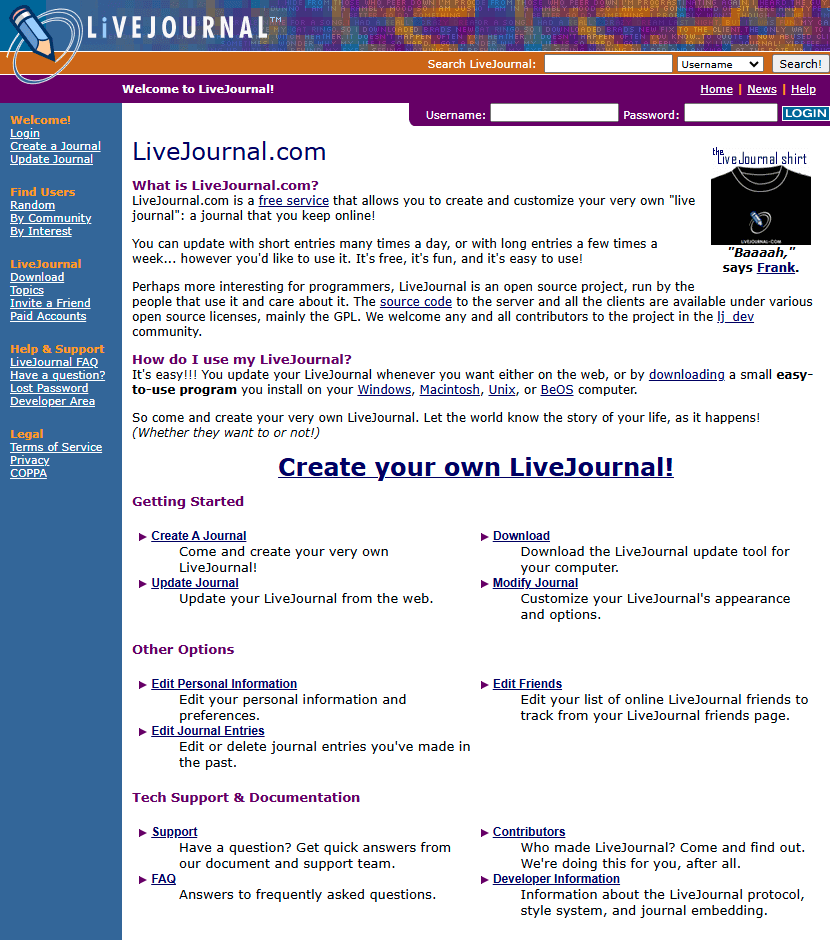
The 2003 homepage below is particularly revealing: it introduces personal publishing, advertises customization, and describes joining through a friend’s invitation. It is a view of how the site presented itself then.
Ephemera
Two early homepages, from 2001 and 2003, show how LiveJournal introduced writing, customization, and friends.

Related reading
 THE HOMEPAGE
GeoCities
GeoCities was a web hosting service that let people build personal websites, originally grouped into themed neighborhoods. It helped make the personal homepage a familiar part of the 1990s web. Yahoo acquired the service in 1999 and closed its US operation in 2009.
 THE VISITOR BOOK
Guestbooks
A website guestbook is a public visitor log where people can leave a name, message, and sometimes contact details or a homepage link. On personal websites, it offered a simple way to acknowledge a visit and respond to the site’s owner.
 THE FEATURE
Buddy Lists
A buddy list is a saved list of people in an instant messaging service, usually showing whether each person is online, away, or offline. It puts your contacts and their availability in the same window.
Sources
- LiveJournal: its origins
- LiveJournal: journals, communities, and user interaction
- LiveJournal: the Friends page
- LiveJournal: entry visibility and security levels
- LiveJournal: community journals
- LiveJournal: userpics
- boyd and Ellison: Social Network Sites (2007)
- Web Design Museum: LiveJournal’s 2003 homepage
- Web Design Museum: LiveJournal’s 2001 homepage