
Glossary term
Chatbots
A chatbot is software you interact with by exchanging messages. Some follow scripts; others generate replies with AI. Long before ChatGPT, people were adding a bot to their buddy list just to have someone—or something—to talk to.
Everybody else could be away. The bot was there.
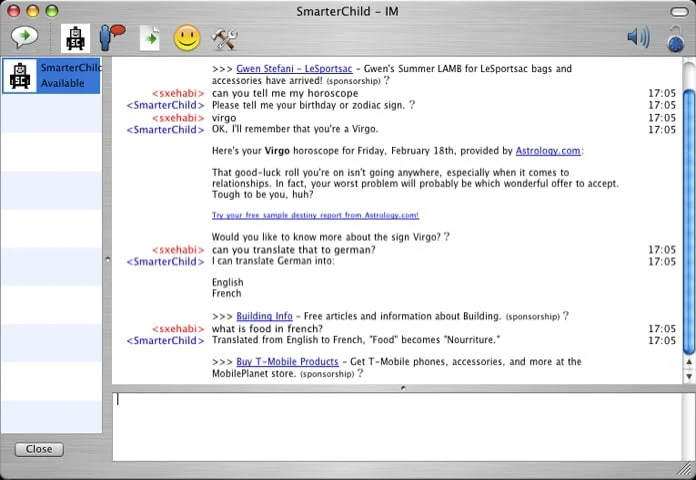
SmarterChild arrived on AOL Instant Messenger in 2001. You added it as a buddy, opened the same little chat window you used for friends, and asked for weather, definitions or sports information. Then, inevitably, people started messing with it. Of course they did. Someone had put a talking computer in the room.
The personality was part of the product
ActiveBuddy’s writers supplied the responses. The system matched patterns and worked out which prepared material to return. A team member even built a profanity handler, because a public-facing chatbot was always going to meet the public.
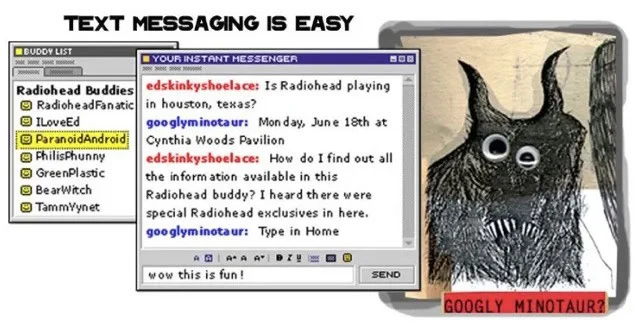
There were promotional bots, too. Radiohead’s GooglyMinotaur answered questions around Amnesiac. A band could appear in the same messaging environment as your friends. The chat window had become a tiny venue, shop counter and information desk.
The box got familiar before the answers got this capable
The idea was older than AIM. Joseph Weizenbaum’s ELIZA, described in 1966, used scripts to turn a person’s words back into a conversation. The technology was limited; the urge to treat a reply as evidence of a mind was already there.
Modern language-model chatbots can produce responses their designers did not write in advance. That is a much larger capability, and it brings different failure modes. But the familiar part is the invitation: type into this box as though somebody is listening. Chatbots went from a novelty in a buddy list to a place people ask for help with work, decisions and private worries. The interface makes that leap feel remarkably small.
Frequently asked questions
Do all chatbots use AI?
No. A chatbot can follow a decision tree or match phrases to prepared replies. Others use language models to generate responses. The chat interface tells you how to interact, not what system is producing the answer.
How do chatbots work?
They receive a message and produce a response using their underlying system: rules, information retrieval, a generative model, or a combination. Access to a live database or another tool is a separate capability; a fluent reply does not show that the bot actually checked a source.
Ephemera
Related reading
 THE OVERVIEW
AOL Instant Messenger (AIM)
AOL Instant Messenger, better known as AIM, was a free messaging service that let people chat in real time and see which friends were online. AOL introduced it in 1997 and discontinued it on December 15, 2017.
 THE FEATURE
Buddy Lists
A buddy list is a saved list of people in an instant messaging service, usually showing whether each person is online, away, or offline. It puts your contacts and their availability in the same window.
 THE NETWORK
Internet Relay Chat (IRC)
Internet Relay Chat, or IRC, is a system for live text conversation across networks of servers. People connect with a client, choose a nickname, and talk in shared channels or private messages.