
Glossary term
AOL CDs
AOL CDs were promotional CD-ROMs containing America Online software and offers for a free trial of its online service. Distributed through the mail and other channels during the 1990s and 2000s, they became a familiar physical artifact of getting online.
The internet kept arriving in the mail. Even if you already had it.
Another envelope. Another shiny disc. Another quantity of free hours that sounded less like a trial and more like a commitment. AOL wanted the disc in your computer; plenty of copies never made it past the kitchen counter.
The software inside the envelope
The disc held software for installing America Online. It came with an offer to try the service, so a person could go from opening the mail to setting up an account. The shiny object was the delivery mechanism; the subscription was the business.
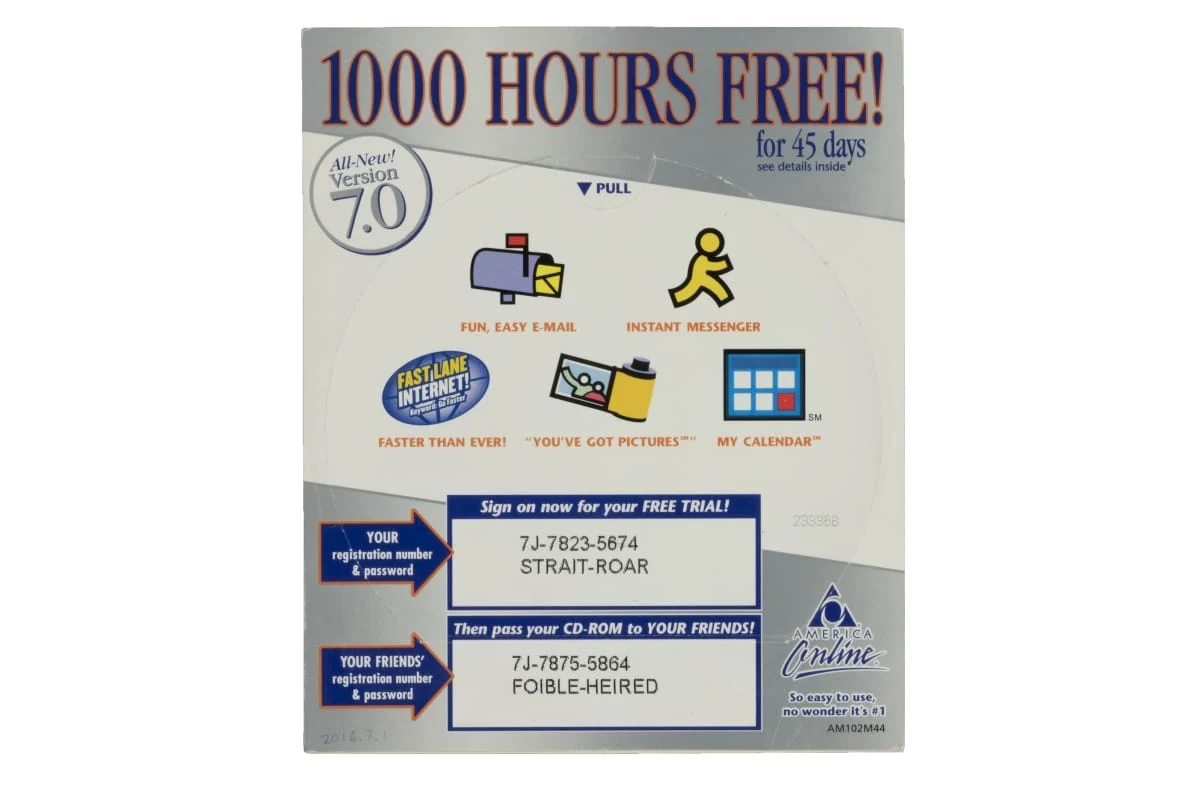
The package sold the experience around the connection too. A 2001 example preserved by The Henry Ford advertises email, instant messaging, photos, and a calendar. The disc was an invitation into a collection of things to do online.
For someone getting online for the first time, the offer was more than a connection. It was email, people to talk to and places to explore, bundled into software that had just turned up in the mail. AIM later gave people a way to keep messaging without an AOL internet subscription.
A distribution strategy you could trip over
Getting the software into someone’s hands could turn curiosity into a paying customer. In a 2014 interview, AOL marketer Jan Brandt described testing direct mail after joining the company in 1993. Boxes and tins made the offer feel like something worth opening.
Then the distribution spread. Discs appeared with magazines, at shops, and in promotional bundles. If you already had AOL, the next copy wasn’t a new world of possibility. It was another disc.
Were the free hours really free?
They were trial offers with conditions, not a permanent free internet connection. The number of hours, time limit, and registration requirements depended on the promotion. The 2001 package shown below explicitly says no credit card was required.
That same package promises 1,000 free hours within 45 days. Forty-five days contain 1,080 hours. AOL was offering you nearly the whole calendar. The time limit belonged to the offer even if the larger number got your attention first.
The business behind the mailings
Brandt recalled an initial campaign costing $250,000 and producing an uptake above 10 percent, with the strongest mailing list reaching 20 percent. Those are her retrospective figures, rather than a universal response rate for every AOL mailing.
The basic logic was straightforward: a discarded disc cost money, but a new subscriber could keep paying. A campaign could be irritating to people who received it and still effective at finding customers.
Different discs, different offers
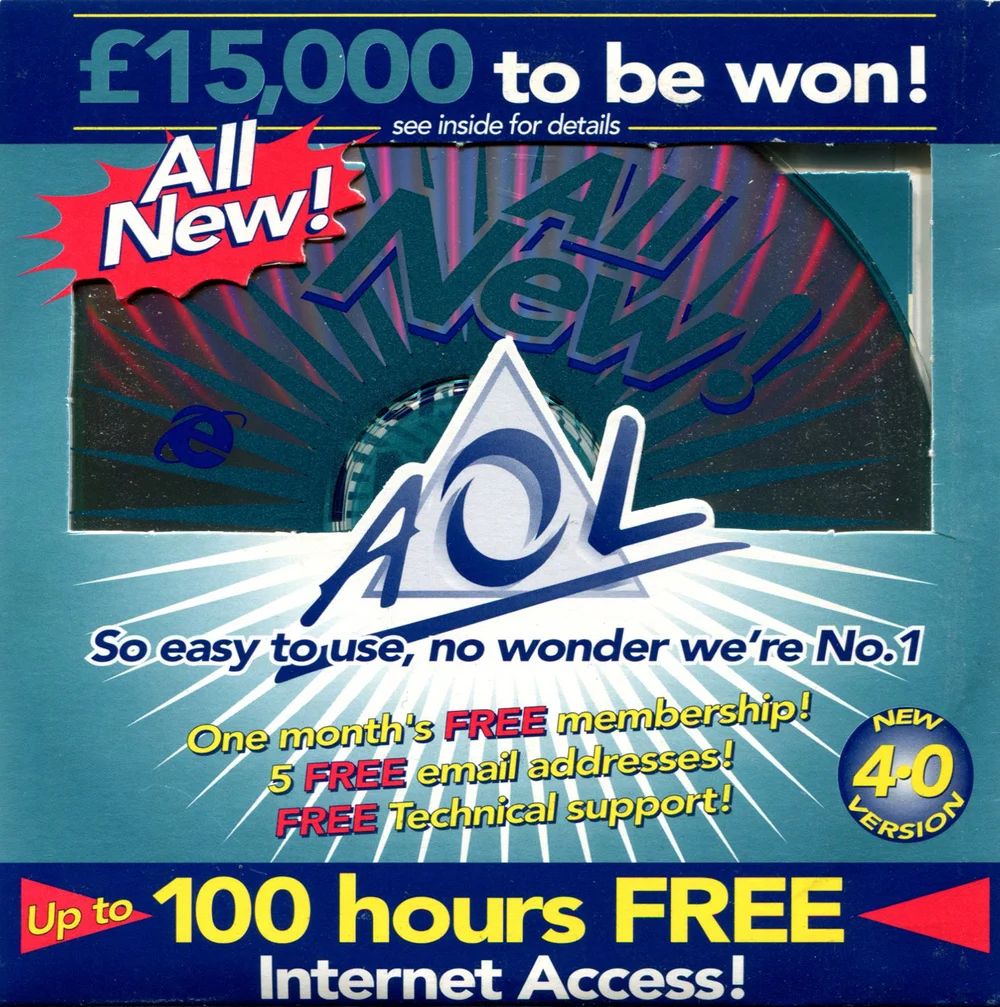
Versions, packaging, offers, and audiences varied. The Centre for Computing History preserves a 100-hour AOL 4.0 offer and a 520-hour AOL 4.0i offer, both catalogued in 1999. Its wider collection includes different versions and trial arrangements.
Even the medium changed. The campaign used floppy disks before CD-ROMs. The animated mailer below is a 1994–1995 floppy promotion: the ancestor of the discs that later accumulated beside the computer.
A second life as art
KUT’s account of Austin artist and engineer Andy Covar describes him collecting hundreds of free AOL CDs in the 1990s and turning them into mobiles or attaching them to trees for the reflected light.
There is a whole other level of CD reuse in Sean E. Avery’s animal sculptures. His 2012 Baby Horn-Rimmed Owl and Peregrine Falcon 2 each used more than 40 CDs. He cut shards, sorted them, and attached them to wire mesh to build up feathers. His documentation identifies recycled CDs, without specifying that they were AOL discs.
A material once used to advertise the internet had become something you could hang in a tree. Elsewhere, the same sort of disc could become the bird.
When did AOL stop mailing discs?
The Smithsonian dates the phase-out of AOL’s direct-to-consumer mailings to 2006. The packages remain a record of a period when getting online could begin with a physical object arriving at your house.
What had once been a recurring nuisance now sits in museum collections. The software, the sales pitch, the packaging, and the question of what to do with the leftovers are all part of the story.
Ephemera
The offers, the mailers, and the afterlife of a shiny disc. The final two works use recycled CDs; their maker does not identify the discs as AOL promotions.






Related reading
 THE OVERVIEW
AOL Instant Messenger (AIM)
AOL Instant Messenger, better known as AIM, was a free messaging service that let people chat in real time and see which friends were online. AOL introduced it in 1997 and discontinued it on December 15, 2017.
 THE NUMBER YOU DIALED
Bulletin Board Systems (BBS)
A bulletin board system, or BBS, is a computer service where users can read and post messages and, depending on the system, exchange files, chat, or play games. Early hobbyist BBSes were commonly reached by dialing the host computer over a telephone line with a modem.
 THE HOMEPAGE
GeoCities
GeoCities was a web hosting service that let people build personal websites, originally grouped into themed neighborhoods. It helped make the personal homepage a familiar part of the 1990s web. Yahoo acquired the service in 1999 and closed its US operation in 2009.
Sources
- Smithsonian: the direct-mail campaign and its packaging
- Jan Brandt: first-hand account of the marketing campaign (2014 interview)
- The Henry Ford: America Online CD-ROM and packaging (2001)
- Centre for Computing History: the 100-hour offer (1999)
- Centre for Computing History: the 520-hour offer (1999)
- KUT: Andy Covar’s AOL-disc mobiles
- Sean E. Avery: recycled-CD sculpture technique
- Sean E. Avery: Baby Horn-Rimmed Owl (2012)
- Sean E. Avery: Peregrine Falcon 2 (2012)
- WIPO: AIM’s introduction and availability beyond AOL subscribers