
Glossary term
ASCII Art
ASCII art is a picture or design made by arranging text characters into shapes. It uses letters, numbers, punctuation, and spaces as drawing material, often in a fixed-width font that keeps the characters aligned.
A slash could become a roof. Repeated letters could become shading. Long before a picture needed its own image file, a block of text could carry one.
What does ASCII stand for?
ASCII means American Standard Code for Information Interchange. It is a character encoding with 128 positions, including letters, digits, punctuation, and control characters. Traditional ASCII art draws with the printable characters.
People sometimes use “ASCII art” loosely for other text-based pictures too. It is useful to distinguish the strict character set from the wider family of text art.
Drawing with characters
The shapes and positions of the characters do the work. Slashes can suggest edges, underscores a base, and repeated characters a texture. Dense marks and open spaces can create areas of light and dark.
A drawing can be made by hand in a text editor or produced with a conversion tool. Either way, the arrangement is part of the image: changing the spacing can change the picture.
Why does ASCII art need a monospace font?
In a monospace, or fixed-width, font, each character occupies the same horizontal space. That keeps columns and diagonals aligned. A proportional font gives different characters different widths and can pull the drawing apart.
Line wrapping can damage it too. A narrow display may send the end of one row onto the next. Preserving spaces, line breaks, and a fixed-width font is often enough to make a plain-text drawing readable again.
Pictures that traveled as text
Email signatures, Usenet groups, and text files gave ASCII art places to circulate. The preserved alt.ascii-art FAQ documents a community that posted drawings, requested subjects, discussed tools, and revised one another’s work.
The appeal was practical as well as playful. A picture could travel inside the same text channel as the conversation. You did not always need an attached image or a graphical display.
How is ASCII art different from ANSI art?
Strict ASCII art uses the printable ASCII characters. ANSI art can use terminal control sequences for effects such as color and cursor positioning; artwork associated with DOS also often uses an extended character set.
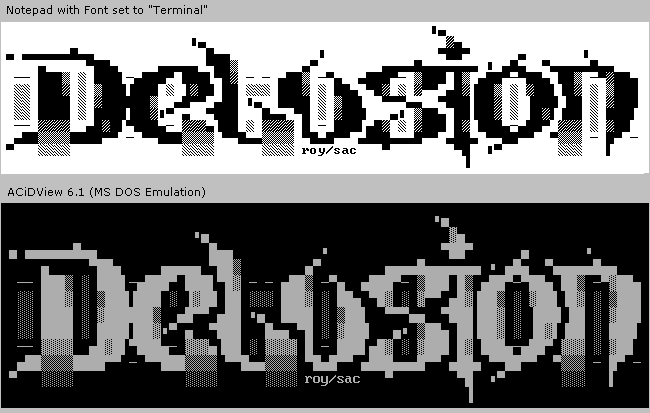
The 2007 comparison below shows a related display problem: the same block-style artwork looks different in Windows Notepad and a viewer emulating its intended DOS display. It is a useful example of why character set and rendering matter.
Faces at the small end of text art
A basic face such as :-) can be understood as a very small text picture. In everyday use, emoticons usually signal feeling or tone; ASCII art can depict a whole scene, an object, or a decorative heading.
You could add a smile to a sentence or sign off with an elaborate drawing. Both made a plain-text message feel a little more like it came from a person.
Can you copy and paste ASCII art?
Usually, yes, if the destination preserves the characters and spacing. Use a preformatted text field or code block where appropriate, and keep the artist’s signature and credit with the work.
Plain text is a medium, not a permission slip. Check the source’s reuse terms. The examples below identify their creators and dates rather than presenting every circulating drawing as anonymous internet folklore.
Ephemera
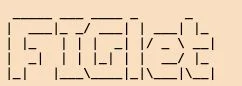
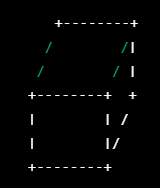
A text-art masthead, a 2007 rendering comparison, and a small modern example. The dates and credits matter as much as the characters.
Related reading
 THE EXPRESSION
Emoticons
Emoticons are combinations of typed characters that suggest a face, expression, or gesture, such as :-) or ;-). They add cues about feeling or tone to a text message without requiring an image.
 THE NUMBER YOU DIALED
Bulletin Board Systems (BBS)
A bulletin board system, or BBS, is a computer service where users can read and post messages and, depending on the system, exchange files, chat, or play games. Early hobbyist BBSes were commonly reached by dialing the host computer over a telephone line with a modem.
 THE PERMANENT WORKSITE
Under Construction GIFs
Under Construction GIFs are small web graphics, often animated, that signal an unfinished or changing website. Road barriers, warning lights, tools, and construction signs became familiar motifs on personal homepages in the 1990s.
Sources
- alt.ascii-art FAQ: character sets, fonts, wrapping, and community practice (2003 version)
- ASCII Art Dictionary: community resources and period tutorials
- Roy/SAC: the Notepad and ACiDView comparison (2007, public domain)
- Susbush: a simple ASCII cube (2024, CC0)
- RFC 20: the ASCII character set (1969)
- FIGlet: making large letters from ordinary text